×

India has a unique education system designed to uphold its nation’s culture, history, values, and customs. India is the largest education systems of the World, with a diverse range of educational institutions catering to millions of students across the world.
In the Indian system, higher education includes the education imparted after the 10 + 2 stage – ten years of primary and secondary education followed by two years of higher secondary education. In general the medium of instructions in India is English. English is widely spoken and understood in India.
PRIMARY, SECONDARY & HIGHER SECONDARY EDUCATION-
India has a unique education system designed to uphold its nation’s culture, history, values and customs. India is the largest education system of the World, with a diverse range of educational institutions catering to millions of students across the world.
In the Indian system, higher education includes the education imparted after the 10 + 2 stage – ten years of primary and secondary education followed by two years of higher secondary education.In general the medium of instruction in India is English.English is widely spoken and understood in India.
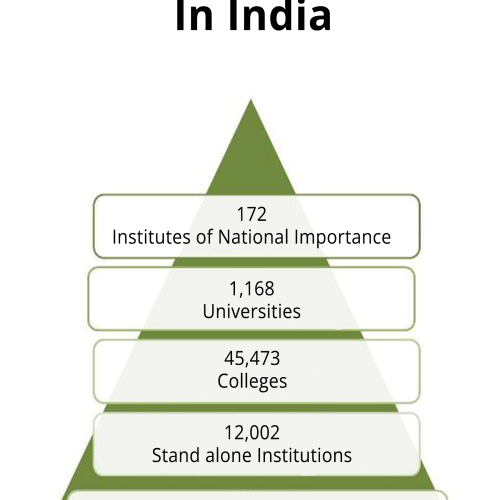
Universities and specialized institutes are the centres for higher education in India. The studies and disciplines cover a wide range of subjects from poetry to computer engineering to space research. Most of the universities and higher centres of learning and research are autonomous in function. A good number of universities have a federal structure composed of affiliated colleges on one tier and the university departments on the other.
There are a number of colleges and universities in India both government as well as private recognized by government, which are imparting academic and professional education. Detailed and elaborate information on these colleges and universities can be accessed on the website of the University Grants Commission (UGC) www.ugc.ac.in.
On the basis of management the universities are classified as:

These are set up through an Act in Parliament. The establishment and operation are funded by the Union Government.

These are set up through an Act in the State Legislature. The state universities are primarily funded and operated by the State Government.

These are set up through an Act in the State Legislatures. It includes specialized institutions and multidisciplinary research universities.

These are well-performing institutes that are declared to be of equal standing as the universities by the Central Government on the advice of the Union Grants Commission (UGC).

These are eminent institutions of India that are known to develop highly skilled individuals. They are funded by the Government of India and include all the IITs, IIITs, NITs and AIIMs institutes.

Undergraduate courses, in general, are of three years leading to the final examinations. The universities and higher institutes award Bachelor’s degree in Arts, Science, Commerce, etc. However, undergraduate courses leading to a first degree in professional subjects like Engineering, Medicine, Dentistry and Pharmacy are of a longer duration ranging from four to five and a half years.
Courses in Arts, Science and Medicine usually last two years ending with a Master’s degree. For Engineering and Technology, the courses are for one and a half years. Specialized fields for instance, for a Bachelor of Education (B.Ed) degree, the possession of a Bachelor’s degree in any other discipline is required before admission can be obtained. Some universities and higher institutes offer a diploma or a certificate course of shorter duration in disciplines like Engineering, Agricultural Sciences and Computer Technology. The duration of these courses varies from university to university.


IMPORTANT: International students going to India for higher education must deposit tuition fee for one year to the concerned university/college. It may also be ensured that the foreign student has a minimum amount of US$ 2000 readily available to meet day to day expenses if the duration of course is for more than one year and US$ 1000 if the course is less than one year. International students must register themselves with the Foreigners Regional Registration Office of the concerned state immediately on arrival in India(www.immigrationindia.nic.in).
For admission to undergraduate courses, in the universities or institutions of higher education in India, the candidates need to complete 12 years of schooling having passed in 5 subjects in the Senior Secondary or equivalent examination with 60-70% marks in their qualifying examinations. For admission to undergraduate technical courses, the candidates should obtain 75-80% in their qualifying examinations which should include the subjects: Physics, Chemistry, Biology, Mathematics and English. Admission requirements to undergraduate pass courses are not very rigid. Admission in non-professional colleges is usually not difficult,except in the case of some selected colleges in metropolitan towns where there is strong competition.Entry into professional colleges, e.g. in Medicine, Engineering, Pharmacy, Dentistry, Architecture,Management or Agriculture is difficult because of the limited number of seats available, and is generally based on a separate admission test. However, in some cases, overseas applicants can be admitted against nominated seats/paid seats according to prescribed guidelines of the Indian university concerned.
Foreign students need to get their year 12 certificate equated by the Association of Indian Universities (AIU)
which has been accepted as an accredited agency at the national level for undertaking the assessment/ for equating of foreign academic credentials with the Senior Secondary Examination (Class XII) in India and is
Considered to be the minimum admission requirement for the first degree programme (www.aiu.nic.in).
Indian universities do not give blanket recognition to the degree/diploma/certificate awarded by foreign.
MEDIUM OF INSTRUCTION: In most of universities the medium of instruction is English. In case of professional courses, and for science and technical subjects, English is exclusively used for teaching. For the Humanities, Social Sciences and Commerce faculties, the medium of instruction is both in English and in regional languages. Postgraduate education is conducted in English in most of the centres.